
Baby wipes ingredients can look complicated at first, but most serve a specific purpose in the formula. A typical wipe combines a substrate—the material you physically wipe with—with a water-based solution containing ingredients that cleanse, moisturize, preserve the product, adjust its feel, or add fragrance.
For parents, understanding these ingredients can make product comparisons much easier. You do not need a chemistry degree or a list of ingredients to fear. Instead, it helps to understand why each ingredient is present and whether it fits your child’s individual skin needs.
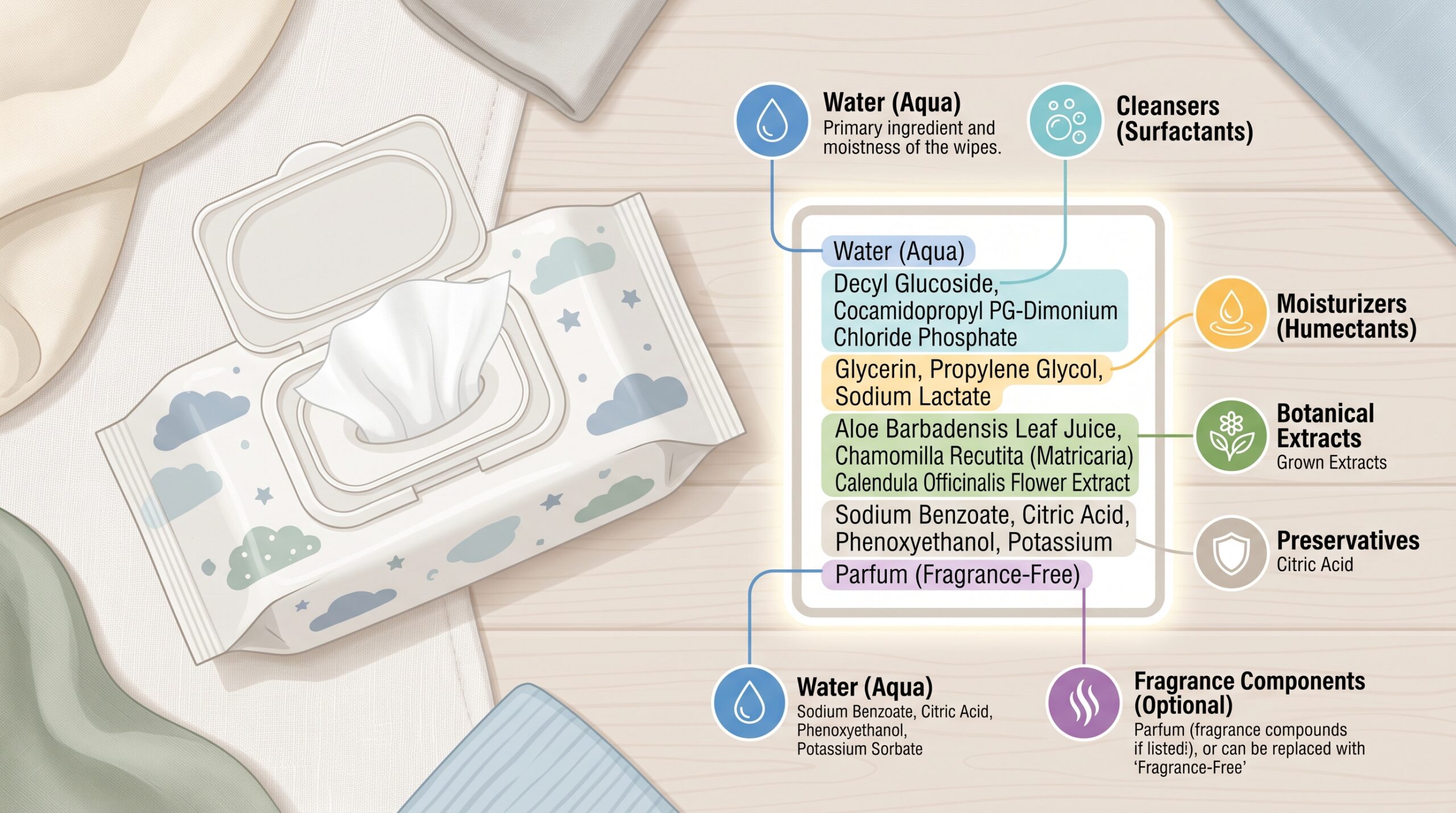
Understanding ingredient functions makes baby-wipe labels easier to evaluate.
How to Read a Baby Wipes Ingredient List
Ingredient order provides useful context. Under the U.S. Food and Drug Administration’s cosmetics labeling requirements, cosmetic ingredients generally must be listed in descending order of predominance. Ingredients at concentrations of 1% or less may be listed in any order after ingredients present above that level.
That means ingredients near the beginning of a baby wipes ingredient list usually make up more of the formula than ingredients near the end. However, position alone does not tell you whether an ingredient is beneficial, unnecessary, or irritating. Some ingredients perform their function effectively at very low concentrations.
The better question is: What job does this ingredient perform?
Water and Humectants: Building the Moisture Base
Water is commonly the first ingredient in wet wipes because it acts as the carrier for the cleansing solution.
Next, you may see a humectant such as glycerin. Humectants attract and hold water, helping prevent a cleansing formula from feeling excessively drying. Glycerin is widely used across skin-care and personal-care products for this purpose.
For example, the formula used in Maxim Organic Cotton Baby Wipes begins with water and glycerin. Reading these ingredients by function immediately provides more useful information than simply sorting them into “natural” and “chemical” categories.
Cleansing Agents: How a Wipe Removes Mess
Water alone does not efficiently remove every type of residue. That is why wipes often contain small amounts of surfactants, or cleansing agents.
Ingredients such as caprylyl/capryl glucoside and lauryl glucoside help water interact with oils and surface debris so they can be lifted away by the wipe. Glucoside-based surfactants are frequently used in personal-care cleansing systems where formulators want cleaning action without creating the heavy lather associated with shampoos or body washes.
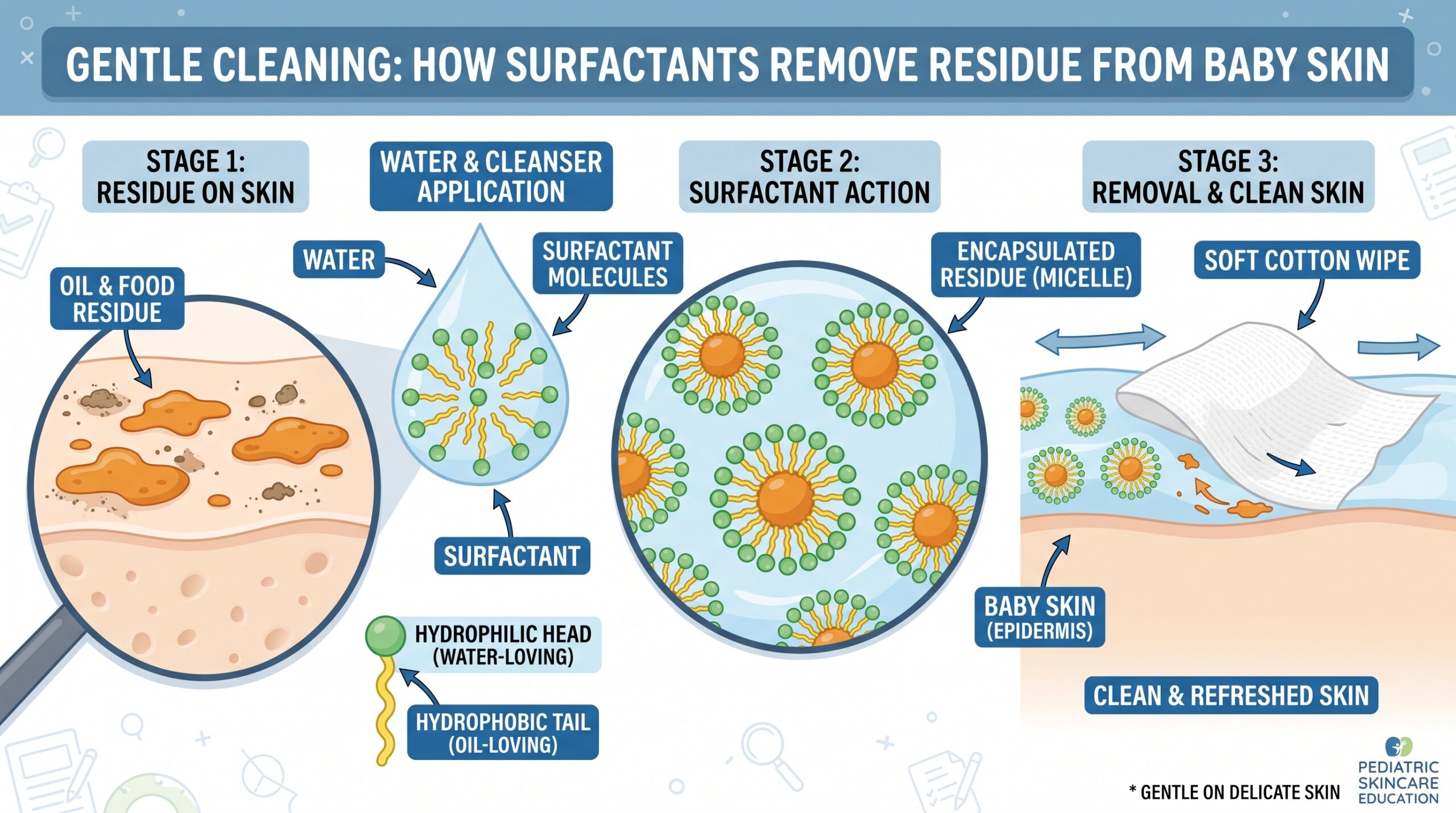
Surfactants help a water-based wipe remove substances that water alone may leave behind.
Moisturizers and Skin-Conditioning Ingredients in Baby Wipes
Baby-wipe formulas may also contain ingredients designed to improve skin feel.
Olive fruit oil, for example, functions as an emollient, while tocopheryl acetate, a form of vitamin E commonly used in cosmetics, can serve as a skin-conditioning ingredient and antioxidant within a formulation.
These ingredients should still be viewed in context. A long list of recognizable plant-derived ingredients does not automatically make one formula appropriate for every child, just as an unfamiliar chemical name does not automatically make an ingredient harmful.
That distinction is one of the most valuable habits parents can develop when comparing skin-care labels.
Botanical Extracts: Natural Still Requires Attention
Botanical ingredients may include chamomile, calendula, honeysuckle, lemon balm, bisabolol, and similar plant-derived components. They are often incorporated into skin-care formulations for conditioning or soothing purposes.
But “natural” should not be interpreted as “incapable of causing a reaction.” The National Center for Complementary and Integrative Health notes that although topical chamomile is generally considered possibly safe when appropriately used, allergic reactions can occur, particularly in people sensitive to related plants. NCCIH guidance on chamomile safety
For children with known allergies or unusually reactive skin, ingredient familiarity and previous tolerance may matter more than how appealing a botanical sounds on the package.
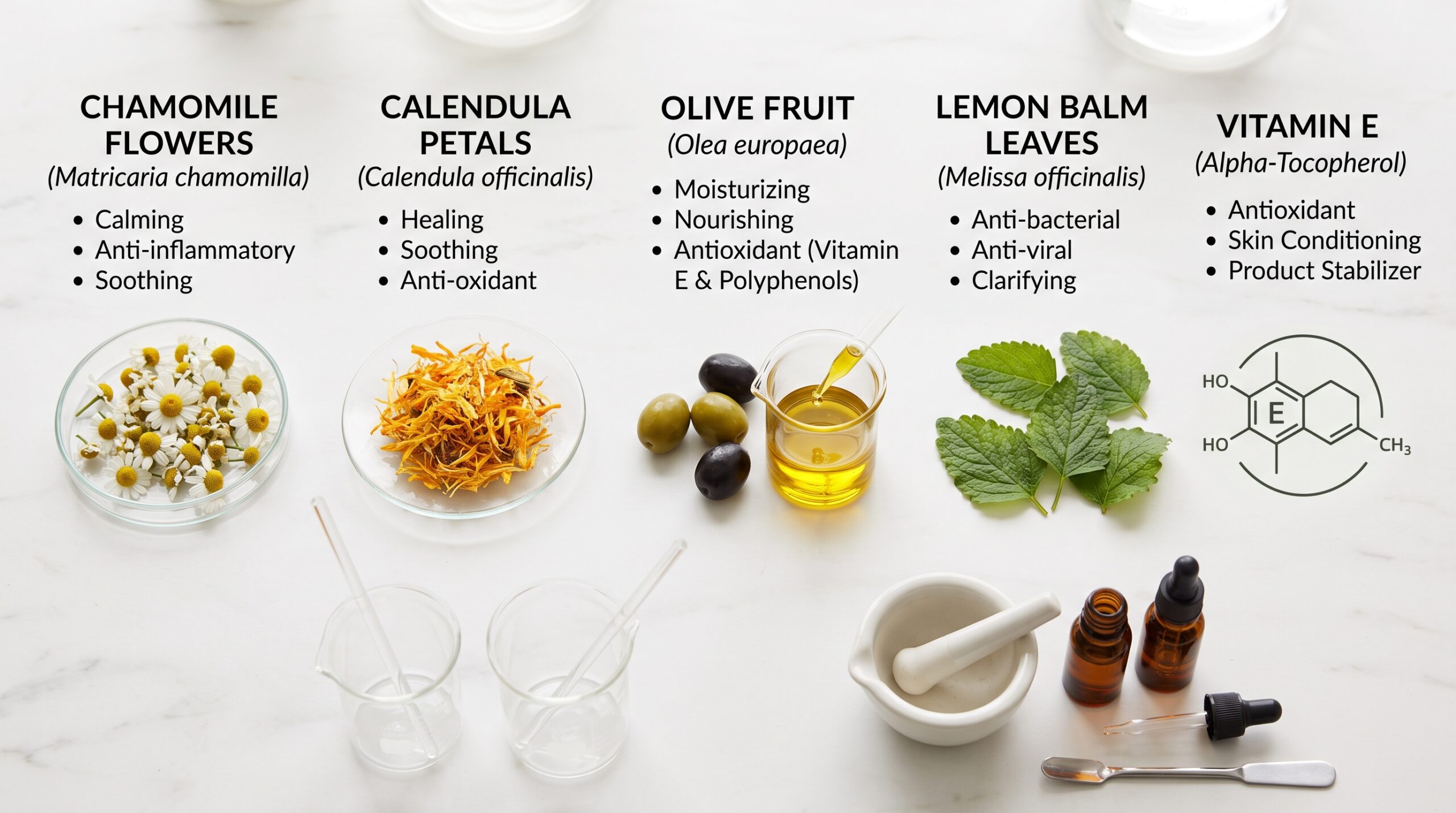
Botanical extracts can serve useful formulation roles, but natural origin does not guarantee universal skin tolerance.
Why Preservatives Are Used in Baby Wipes
Preservatives sometimes receive negative attention, but their purpose is important. A package containing water and repeatedly exposed to hands and air needs protection against microbial growth.
You might encounter names such as sodium benzoate, potassium sorbate, benzyl alcohol, dehydroacetic acid, benzoic acid, or sorbic acid in wipe formulas.
Rather than treating the word “preservative” as automatically undesirable, consider the complete formulation and your child’s known sensitivities. The FDA specifically recommends reviewing cosmetic ingredient panels when trying to avoid substances associated with previous allergic reactions. FDA guidance on allergens in cosmetics
A properly preserved water-based product serves a very different purpose from an unnecessary decorative additive.
Pay Special Attention to Fragrance
Fragrance deserves separate attention because individual tolerance varies considerably.
A label may list “fragrance” as well as named fragrance components such as linalool or coumarin. Their presence does not mean every user will experience irritation, but families managing eczema or fragrance sensitivity may prefer to compare fragranced and fragrance-free options carefully.
The American Academy of Dermatology recommends fragrance-free rather than merely “unscented” products for children with eczema and notes that wipes themselves can sometimes act as triggers. American Academy of Dermatology guidance for eczema-friendly products
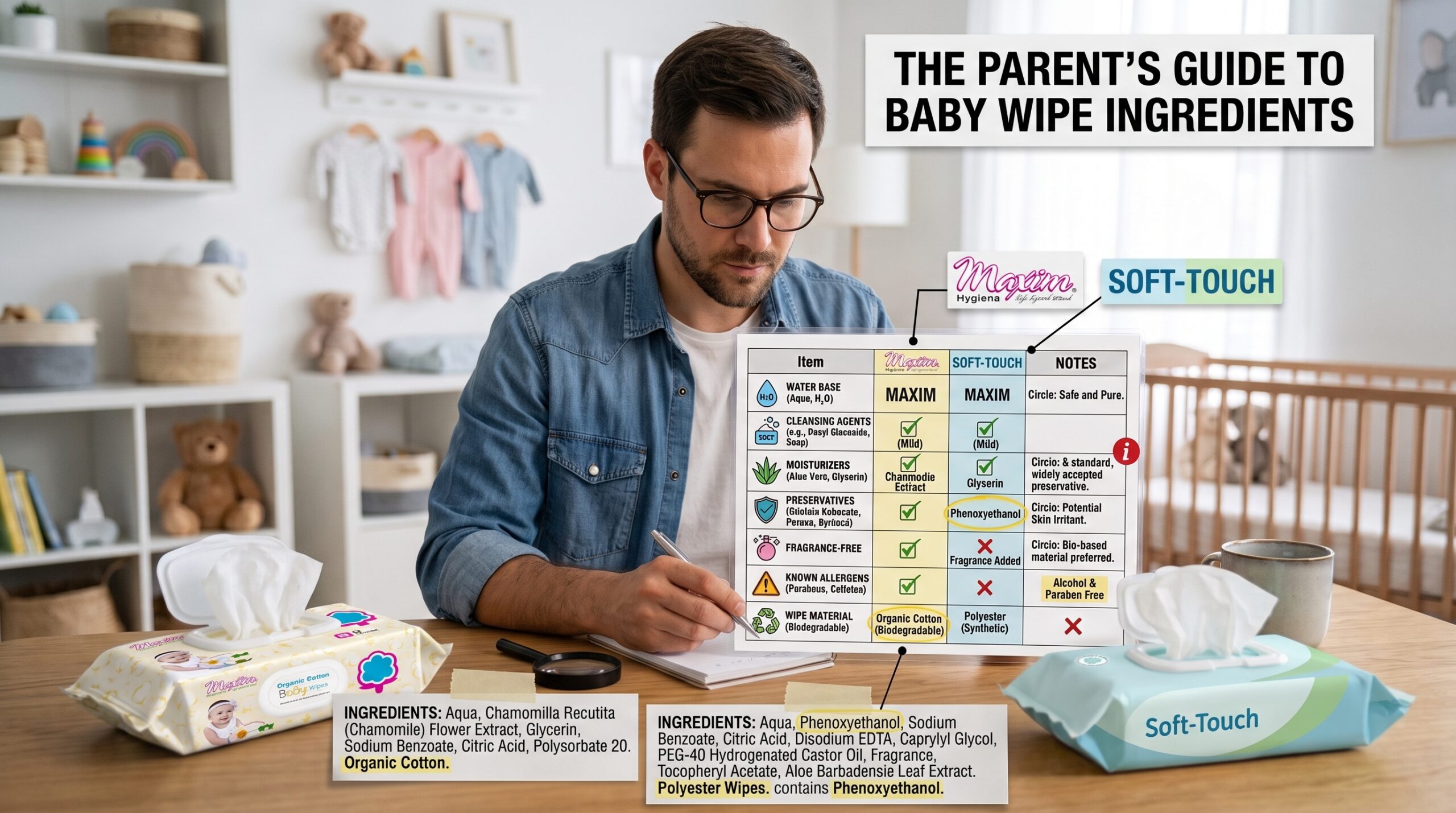
Comparing ingredient functions is more informative than judging a wipe by front-of-package claims alone.
Baby Wipes Ingredients: A Simple Reading Checklist
When comparing baby wipes, first identify the wipe material and then read the liquid formula separately. Look at the first several ingredients to understand the base of the formulation. Identify the cleansing agents, moisturizing or conditioning ingredients, preservatives, botanical extracts, and fragrance components.
Most importantly, evaluate ingredients according to your child’s history. If a baby develops persistent redness, itching, swelling, or another reaction after using a product, discontinue it and discuss the symptoms with an appropriate healthcare professional.
Ingredient literacy is not about finding a mythical product containing “no chemicals.” Everything in a formulation has a chemical identity, including water and plant extracts. The goal is to understand what is present, what it does, and whether it makes sense for your family’s needs.
That approach turns a complicated ingredient panel into a practical decision-making tool—and helps parents look beyond marketing claims when choosing products that regularly touch delicate skin.