Understanding the Basics of Menstrual Cup Design
Traditional menstrual cups are typically bell-shaped devices made from medical-grade silicone, designed to collect menstrual fluid rather than absorb it. They can be worn for up to 8–12 hours depending on flow, after which they must be removed, emptied, rinsed, and reinserted.
While highly effective, this process can present challenges in public or shared restroom settings where privacy and access to clean water may be limited. According to research published by the National Institutes of Health (NIH), proper hygiene during menstrual product handling is essential to reduce the risk of infections and maintain vaginal health.
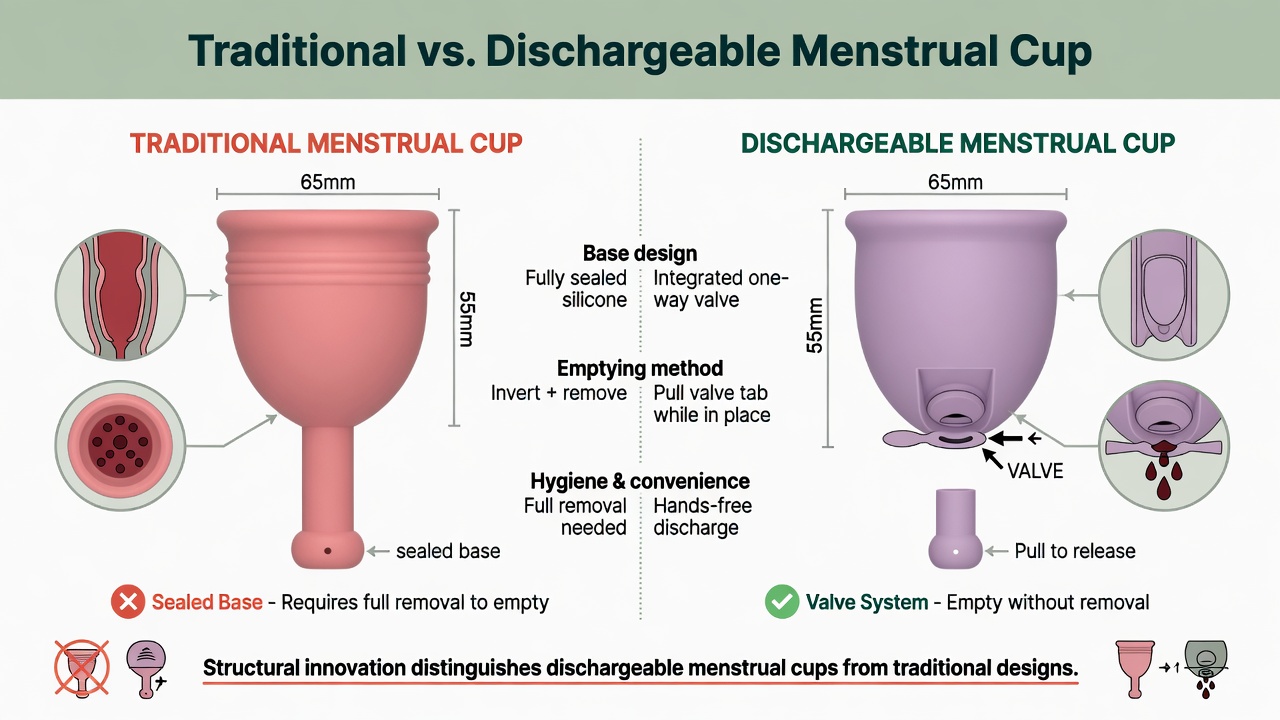
Traditional and dischargeable menstrual cups differ in how they empty, clean, and support hygienic period care.
The Dischargeable Feature: A Functional Upgrade
The defining characteristic of a dischargeable menstrual cup is its built-in valve or release mechanism. Instead of removing the entire cup to empty its contents, users can simply release the collected fluid while the cup remains in place.
This design offers several key advantages:
- Reduced handling: Minimizes direct contact with menstrual fluid
- Improved convenience: Ideal for use in public restrooms
- Extended usability: Allows for quick emptying without full removal
From an engineering perspective, this feature requires precise control over fluid dynamics and sealing integrity. The valve must remain leak-proof during normal wear while allowing controlled release when activated.
Organizations like ISO (International Organization for Standardization) emphasize the importance of product safety and material integrity in personal care devices, particularly those used internally. Ensuring that the valve mechanism does not compromise the cup’s structural reliability is a critical aspect of its design.
Hygiene and Safety Considerations
While the dischargeable feature enhances convenience, it also introduces new considerations for hygiene. Because the cup remains inserted for longer periods, maintaining cleanliness becomes even more important.
This is where integrated sterilization solutions come into play. Products like the MaxiCup Dischargeable Menstrual Cup with Sterilizer demonstrate how innovation extends beyond the cup itself. By including a dedicated sterilizer, users can ensure that the device is properly sanitized between cycles.
The Centers for Disease Control and Prevention (CDC) highlights sterilization as a key factor in preventing microbial growth on reusable medical devices. Although menstrual cups are not classified as medical devices in all jurisdictions, applying similar hygiene standards is a best practice.
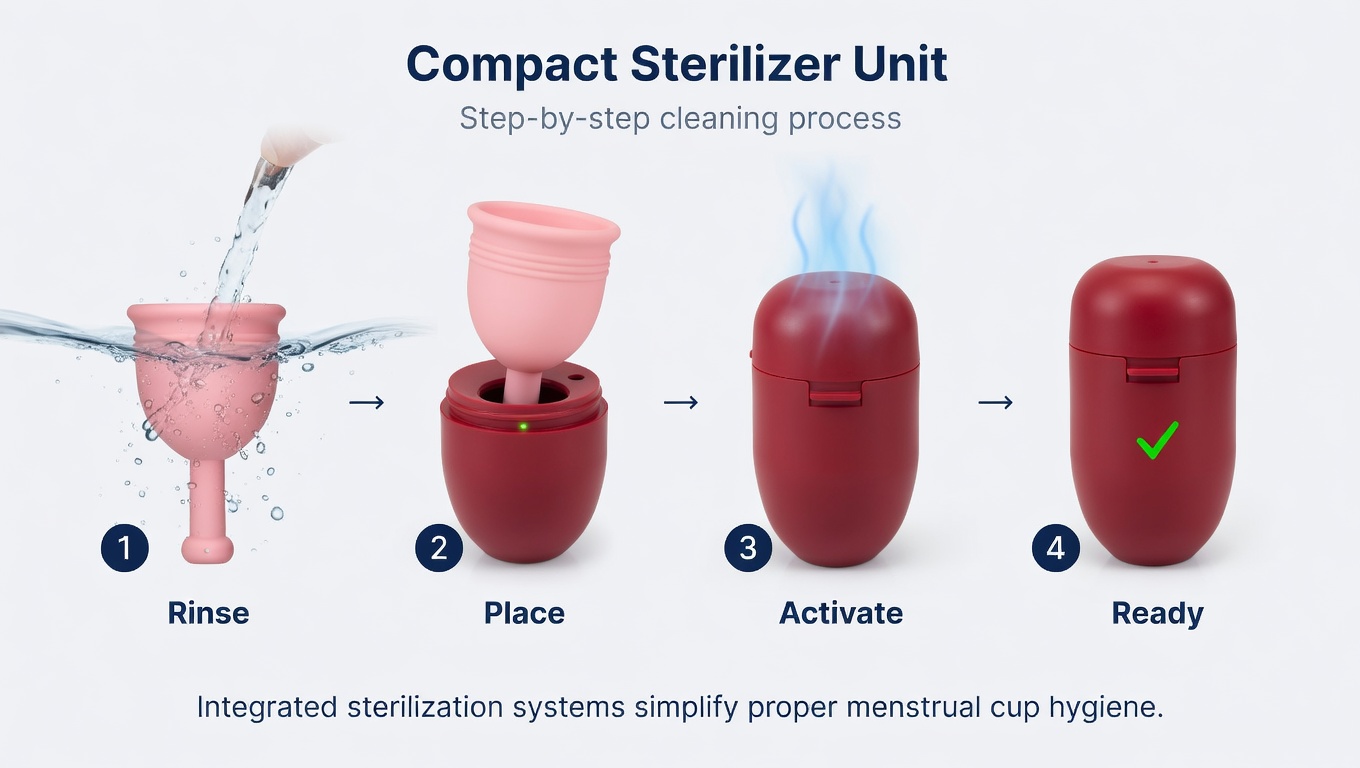
A compact sterilizer unit simplifies menstrual cup cleaning with a quick step-by-step process.
User Experience: Comfort Meets Confidence
Beyond technical functionality, the dischargeable design also improves the overall user experience. For many first-time users, one of the biggest barriers to adopting menstrual cups is the perceived difficulty of removal and reinsertion.
By reducing the frequency of full removal, dischargeable cups:
- Lower the learning curve for beginners
- Reduce discomfort associated with repeated insertion
- Increase confidence in managing menstrual flow throughout the day
Additionally, the use of medical-grade silicone, widely recognized for its biocompatibility, ensures that the material remains safe for prolonged internal use. Studies referenced by organizations such as the U.S. Food and Drug Administration (FDA) indicate that high-quality silicone is non-toxic, hypoallergenic, and resistant to bacterial growth when properly maintained.
Environmental and Practical Impact
From a sustainability standpoint, dischargeable menstrual cups maintain the core advantage of reusability while improving usability. A single cup can last for years, significantly reducing waste compared to disposable pads and tampons.
However, the added convenience may also increase adoption rates among users who were previously hesitant, amplifying the overall environmental benefit. This aligns with global sustainability goals promoted by organizations like the United Nations Environment Programme (UNEP), which advocate for reducing single-use plastic waste.

Modern menstrual solutions support sustainable, convenient period care for daily life.
Final Thoughts: Innovation That Solves Real Problems
The dischargeable menstrual cup is not just a minor design tweak, it’s a thoughtful response to real-world user challenges. By combining engineering precision, hygiene awareness, and user-centered design, it bridges the gap between sustainability and practicality.
As menstrual health continues to evolve, innovations like these demonstrate that progress isn’t just about creating new products, it’s about refining existing solutions to better fit into everyday life.