Once a month we choose one woman to feature in our Fierce Woman Series based on extraordinary initiatives she is taking to make positive changes in the world. We like to define and call these women “fierce women.” This month in honor of Father’s Day this Sunday we wanted to also honor two fierce men that have taken a fierce stand for feminine hygiene.
There are many words that send men running for the hills. Babies. Marriage. Periods. Vaginas. Tampons. I could go on. Many men want vaginas to remain a black box and sadly, they don’t care to distinguish between the diaper aisle and feminine hygiene aisle at the drug store. And though most guys tune out when we talk about being gassy and bloated, some men pay attention. Primarily it is our fathers and husbands who love us enough to want to help.
This post aims to celebrate those few men who looked beyond their glee (at not having vaginas) and their aversion to our periods and empathized with us. Going beyond running to the store late at night, the following two men provided alternative solutions that changed the feminine hygiene industry, all in order to help and protect the women they loved.
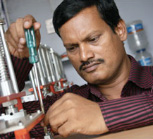
Arunachalam Muruganantham, changing the concept of feminine hygiene for women in India
The first is a man named Arunachalam Muruganantham. Think it’s hard to pronounce? Then think about what he did. Knowing his wife was using rags instead of costly sanitary napkins, Muruganantham was inspired to develop something that would let her deal with her period more easily. To understand what she and other women go through, he fashioned himself a personal menstruating uterus by filling a bladder with goat’s blood and squeezed it every now and then for a whole week to understand the biological, social, and psychological effects of menstruation.
Society, including his wife and mother, rejected him and threw him out of the house, but undeterred he went on to seek a solution for the majority (70%) of women in rural India who cannot afford hygiene products and many (88%) who resort to using dirty rags, newspapers, dried leaves, and even ashes during their periods, because they just can’t afford sanitary napkins. After studying samples of American products, he created a machine which can produce up to 1,000 sanitary napkins a day. They retail for about $.25 for a package of eight.
In addition to providing women with cheap and hygienic products, he has provided many women with a livelihood. Financial independence in India is strongly linked to empowerment, decision making abilities, and a sense of self-worth. Muruganantham’s company, Jayaashree Industries, helps rural women buy one of the $2,500 machines through NGOs, government loans, and rural self-help groups. “We can create 1 million employment opportunities for rural women and expand the model to other developing nations,” he said at an INK conference in Jaipur, Rajastan. Today, there are about 600 machines deployed in 23 states across India and in a few countries abroad.

Kenneth Alvandi, Maxim Hygiene Product’s Founder (pictured here with his favorite mug that he uses to drink tea from every day)
The second man who has changed the industry is Ken Alvandi, the founder of Maxim Hygiene Products. He was inspired by the women he loved most in his life – his wife and two daughters. He was also driven by a mindset that centered around three tenets: the body, earth, and health. Combined with his years of experience in feminine hygiene manufacturing, Kenneth looked to develop and offer an innovative solution for minimizing the health and environmental risks posed by conventional tampons. Such risks include irritation, itchiness, exposure to dioxins and the use of non-renewable resources. In recognition of this, Kenneth created the Maxim brand, a feminine hygiene option that is both eco- and health-friendly, primarily made with non-itchy materials like cotton that are hypoallergenic and chlorine/dioxin free!
So what can we learn from these men? Look around you and see what issues are affecting the people you love or the places you live. There is always someone who can be helped. Suffering and need come in all types of packages. Make a change. Volunteer. If you see an issue, try to solve it. This is the era of startups and innovation- young people are finding solutions to problems that have been around forever and new problems that are being created everyday. We have more tools at our fingertips, more technology and more interconnectedness to collaborate with and build upon the genius of others.
Isaac Newton, the founding father of gravity, once said, “Stand on the shoulders of giants.” We should never stop improving. Change the status quo and meet a need – you will be irreplaceable. Arunachalam and Kenneth, our two fierce men in feminine hygiene saw a need, they saw problems and they both created solutions that have revolutionized the industry. And for that, we have another reason to be thankful this coming Father’s Day!