
Organic tampons without applicator offer compact period protection with fewer components to carry and discard. Instead of using a cardboard or plastic applicator, you insert the tampon with a clean finger, giving you direct control over placement.
If you are new to non-applicator tampons, the smaller format may look unfamiliar. Understanding their materials, insertion method, absorbency options, and safety guidelines can help you decide whether they suit your routine.
What are organic tampons without applicator?
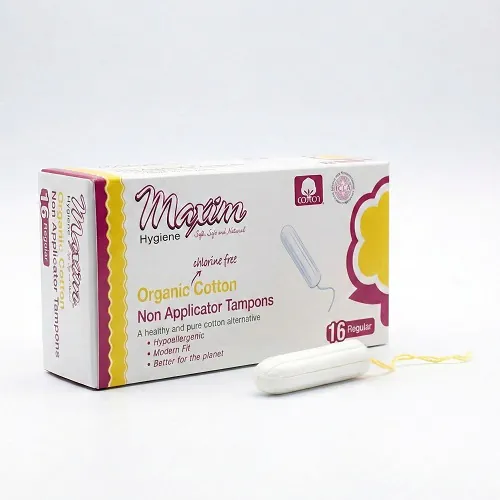
Organic tampons without applicator contain the absorbent tampon and withdrawal cord but no insertion tube. You unwrap it, prepare the rounded tip and string, then guide it into place with your finger. Once correctly positioned, you should not feel it during normal movement.
Maxim Non-Applicator Tampons use a certified organic cotton absorbent core and cotton withdrawal cord. Each tampon has a rounded tip and is individually wrapped for portability.
Benefits of organic tampons without applicator
Less material per product
Choosing organic tampons without applicator reduces the number of components used for each tampon. Maxim lists an organic cotton core, cotton withdrawal cord, clear cellophane protective wrap, and cardboard packaging.
Compact and easy to carry
Without an applicator, tampons take up less room in a purse, pocket, desk drawer, or travel kit. The individually wrapped format helps keep unused products protected until needed.
Direct control during insertion
Using a finger allows you to adjust the angle and depth gradually. Some experienced tampon users find this precise and straightforward after learning the technique.
Transparent materials
Maxim describes its non-applicator tampons as fragrance-free and made without viscose or rayon, dyes, plastics, pesticides, herbicides, or petrochemical byproducts. They are available in Regular, Super, and Super Plus absorbencies.
How to use organic tampons without applicator
- Wash and dry your hands. Clean hands reduce the chance of transferring bacteria.
- Open the wrapper. Remove the protective wrapping without touching the tampon more than necessary.
- Prepare the string. Gently pull the withdrawal cord so it hangs freely and remains outside the body.
- Find a comfortable position. Sit on the toilet, squat slightly, or stand with one foot raised.
- Relax and angle toward your lower back. Vaginal insertion generally follows a backward angle rather than straight upward.
- Insert with your index finger. Guide the rounded end inward until the tampon sits comfortably and you no longer feel it.
- Confirm the string remains outside. Use the string for removal.

Choosing the right absorbency
When selecting organic tampons without applicator, use the lowest absorbency that manages your current flow. Regular is often suitable for light-to-medium flow, Super for medium-to-heavy flow, and Super Plus for heavier days. Your needs may change throughout the same period, so keeping more than one absorbency available can be useful.
If a tampon leaks well before four hours, consider moving up one level. If removal feels dry or uncomfortable after several hours, try a lower absorbency or an external product on lighter days.
Safety guidance for non-applicator tampons
The U.S. Food and Drug Administration recommends using the lowest absorbency needed, changing tampons every four to eight hours, and never wearing one tampon for longer than eight hours.
- Use a new tampon every time and never reuse one.
- Use tampons only during menstruation.
- Wash your hands before and after insertion.
- Do not use a tampon if its wrapper is damaged.
- Stop use and contact a healthcare professional if insertion causes unusual pain or you develop unexpected symptoms.
- Seek urgent care for possible toxic shock syndrome symptoms, including sudden fever, vomiting, diarrhea, dizziness, fainting, or a sunburn-like rash.
Applicator versus non-applicator tampons
When comparing applicator styles with organic tampons without applicator, remember that an applicator may feel easier for beginners because it guides placement. A non-applicator tampon is smaller, uses fewer components, and lets you control insertion directly. Neither style is automatically better; comfort, mobility, anatomy, and personal preference all matter.
For another non-applicator perspective, read how Maxim responded to the O.B. Ultra tampon shortage. If you are switching from applicator tampons, practice at home on a moderate-flow day when insertion may feel easier. Never force a tampon. If it feels uncomfortable, remove it and try again later with a fresh product.
Are organic tampons without applicator right for you?
Organic tampons without applicator may suit shoppers who want a compact design, certified organic cotton, clear material information, and less applicator waste. Maxim’s rounded tip, cotton withdrawal cord, individual wrapper, and three absorbency choices support a flexible period routine.
Explore Maxim Organic Cotton Non-Applicator Tampons in Regular, Super, and Super Plus.