
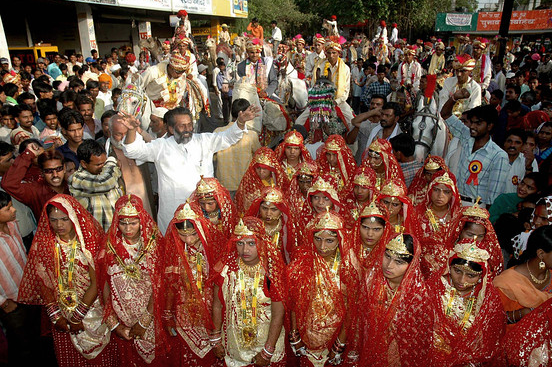
 At the end of April, many Indians celebrated a holiday called Akshaya Tritiya, a day considered to be so auspicious that marriages occur in mass. Both an economically efficient and culturally holy day, Akshaya Tritiya is a day when many young girls are married off in arranged marriages. This blog aims to explore the health risks associated with child marriages and to create awareness concerning the physical consequences that accompany such cultural practices.
The practice of child marriage is rife with contention, but in many parts of the world, marrying young girls to older men is a coping strategy used by poorer families to ensure that they can survive another few seasons. In India, one of the main reasons is the dowry system. When girls get married, their parents must give the groom’s parents a certain amount of money or valued goods. This foreshadows a girl’s role in the family as an economic burden – she is an investment that yields no long term returns as she will move in with her husband’s family once married. Other reasons that young girls may get married before the age of 18 are issues of family honor, debts, and power.
This cultural tenet of many communities has established a gender role that is almost inescapable. Once married, a girl becomes a wife. Her priorities and daily life change – she is no longer in control of her fate, but rather, she is a wife – a pawn for her husband and his family’s use. In addition to having less agency in daily life, a girl has less agency over her body. Child brides are likely to be forced into sexual activity with their husbands. This has severe health consequences due to their physical, emotional, mental and sexual immaturity.
Child brides are likely to become pregnant at an early age and there is a strong correlation between the age of a mother and maternal mortality. Girls ages 10-14 are five times more likely to die in pregnancy or childbirth than women aged 20-24 and girls aged 15-19 are twice as likely to die. Young mothers face higher risks during pregnancies including complications such as heavy bleeding, fistula, infection and anemia, which contribute to higher mortality rates of both mother and child.
Sexual intercourse prior to a girl’s full maturation is often also extremely painful— especially when forced. Abrasions and tearing, which can accompany forces sex or may occur in underdeveloped systems, increase the risk that a girl will acquire STIs such as syphilis, HIV or HPV. Health risks are also passed on – children that are born to adolescent mothers have also been shown to suffer from poorer health both in childhood and adulthood.
Girls who marry early are also more likely to suffer abuse and violence, which have inevitable psychological consequences. Studies indicate that women who marry at young ages are more likely to believe that it is sometimes acceptable for a husband to beat his wife, and are therefore more likely to experience domestic violence themselves. Violent behavior can take the form of physical harm, psychological attacks, threatening behavior and forced sexual acts including rape. Abuse can be by the husband or even his family. Many girls that enter families as a bride often become domestic slaves for her in-laws.
Early marriage has also been linked to wife abandonment and increased levels of divorce or separation. Child brides also face the risk of being widowed by their husbands. In these instances, the wife is likely to suffer additional discrimination as in many cultures divorced, abandoned or widowed women suffer a loss of status, and may be ostracized by society and denied property rights. If the girl is uneducated, as is likely since the husband’s family normally does not invest in her future or economic independence, she is unlikely to be able to successfully tackle her hardships.
Studies also show that women who were married at young ages are less likely to affect change in their daughters’ lives, though the desire may be immense. Women are generally unable to assert their desires as they are financially and socially dependent upon their husbands, thus perpetuating the cycle of entrapping young girls in a cultural structure that is based on gender inequality.
What is the solution, then? We must work towards ensuring that all young girls are educated. Financial independence and education are two tenets of empowerment that cannot be replaced. Girls must be educated so that they have a greater chance of making decisions that are in their best interests and so that their options and choices are as unlimited as possible. Agency is based on the choices that girls have.
Why are we covering this story? Well, because we at Maxim, are not just proponents of women’s health when it comes to hygiene products; we care about the general quality of a woman’s life and taking a stand for the protection and care of women everywhere! For those women, such as myself, who are fortunate enough to not have to worry about such circumstances and just read about such things – it is our duty to spread awareness and to help, in whatever way we can, those girls who are unable to help themselves. There are several international organizations doing amazing and progressive work in the field of sexual and reproductive health; many focus on maternal and child health and several focus on teen and adolescent health. For a list of these organizations see below. If you’re interested, volunteer! Read their publications, offer to help, spread the word via social media, or check their websites for their suggestions!
To Learn More:
http://www.childinfo.org/marriage.html
http://ngm.nationalgeographic.com/2011/06/child-brides/gorney-text
http://www.iheu.org/child-marriage-a-violation-of-human-rights
http://www.pbs.org/now/shows/341/facts.html
To Do More:
http://www.icrw.org/what-we-do/adolescents/child-marriage
http://www.icrw.org/publications/how-end-child-marriage
Organizations Involved in MCH and SRH:
http://www.pathfind.org/site/PageServer
http://aed.org/en/index.htm#