
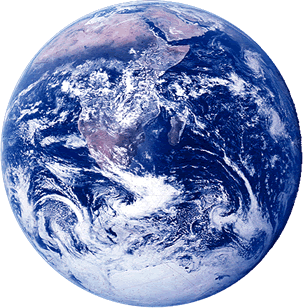
 April 22nd is Earth Day. Earth Day is ignored by many, but it is one of the awareness days that is gaining momentum and importance with each passing year. By 2050, the world population will have surpassed 9 billion people. The UN estimates that 7.9 billion of those people will be living in developing countries. Currently, humanity uses the equivalent of 1.5 planets to support our lifestyles, provide natural resources, and absorb our wastes. Some UN estimates predict that by 2030, we will need two planets to support us at this current trajectory.
A common misconception is that environmental degradation is only a first-world problem. It’s not. Granted, the United States’ ecological footprint is almost the largest in the world, especially proportionate to our population size, but countries like India and China are not far behind. India and China have the two largest populations on the planet, and it is no surprise, that the practices of their populations and lack of government regulations, are harming the environment.
But this is because much of their population has no other choice – they are struggling to make the best living possible with minimal resources. Additionally, degradation affects poorer populations more because there are no protections and securities in place to abate the damage to people’s health, land, or resources. In the poorest regions of the world, an estimated one in five children will not live to see their fifth birthday, primarily because of environment-related diseases.
The habits and impact of those of us living in the developed world are worse because our population is smaller, better educated, wealthier, and elects a government that is well aware of the impending environmental crisis. Because we know the damage we are causing, we can be accountable for our actions and for their consequences. But this responsibility also comes with a unique benefit – because we know, we can cause a change, fuel a movement, and educate others.
The beauty of this age is that we, all humans, are connected. Never before have the boundaries between people, nations, and cultures been so minimal. One click of the mouse can send a message to a girl in rural Mongolia; one activist video made by an NGO can become viral in days and inspire youth empathy around the world.
Earth Day started as one politician’s dream, which then transitioned into a grassroots movement. The power behind it was the passion of the people. People united under one label, as people of the Earth, citizens and stewards of the planet, and began to take charge. Without our voice, our governments are not accountable and there are no signposts for them to follow. Politics remain in the hands of the elite few until we, the citizens, take a stand.
And of those taking a stand, it has been women who have been a powerful driving force. Men have been in power for a long time, and in the next decades, women will be the ones who rise to power and can influence a shift in tide. Women make up more than half of the world’s population.
Developing countries whose growth is stagnating will soon depend on women to not only maintain social rubrics and households but to also work. Women will contribute strength and stability to economies and in doing so, they have the ability to ensure that the future of countries and their roads to success are as green as possible.
During the Industrial Revolution, mechanization and progress were the only goals. Men forged ahead with technology, their strengths being goal-orientation and determination. Much of women’s strengths have been derived from the traditional gender roles of the past – concerning herself with the well-being of those around her, maintaining sustainability, encouraging compassion, and preserving patience. These qualities allow women to not only be aware of their surroundings but to help others around them understand the fragility of the Earth and the consequences of their actions. Our mothers have been moral guides. It is time women become mothers to everyone.
Sustainable, environmentally friendly business practices can be advocated for by women. Recognizing this, many organizations have come together to create WAGE (Women and the Green Economy) to help women become sustainable business leaders and to rally them to support environmental stewardship before Rio +20 so that they can mobilize the world in recognizing the imperative of being environmentally conscious in all aspects of life and policy.
So, how do can you take a stand? There are many ways to make a difference and to help.
1) Educate yourself. Before you can educate anyone else and make them see your point of view, make sure you know what you are fighting for.
2) Make changes in your personal life first before asking others to do the same. Be aware of what your impact is. Reduce your carbon footprint. Recycle. Use products, like Maxim products, that do not excessively contribute to the degradation of the environment.
3) Pledge to do one thing to help the environment, or go to http://act.earthday.org/ to contribute to the “ONE BILLION ACTS OF GREEN” project. Every act counts. Be part of something bigger.
4) Share this with your friends. Start a discussion. Find ways to make your school, workplace, living area, or community more green.
5) Take a stand and be a leader. There are so many causes in this world, but being green requires minimal effort while still having a phenomenal impact.
To learn more about Earth Day or how you can make sustainable changes, check out the following links:
100 facts before Rio +20
Women & the Green Economy
http://www.earthday.org/node/802
Rio+20 – Women for a Sustainable Future
http://women-rio20.ning.com/forum/topics/rio-20-women-s-major-group-the-rio-20-text-is-imbalance-across-th