Earlier this year Newsweek reporter Abigail Jones published a feature cover story boldly entitled “There Will Be Blood: Get Over It” that helped take mainstream the fight to end period shaming. We can’t help but wonder if Chinese Olympic swimmer, Fu Yuanhui, caught wind of that story, while Olympic gold medal swimmer Michael Phelps brought to light something blood related to it – cupping. There must be something stigma-freeing in the water they’re swimming in!
While Fu Yuanhui might not have struck gold at the Rio Olympics’ 4×100 meter medley relay on Sunday, she definitely won over the internet. You’ve undoubtedly heard people throw their comments about periods and taboo into the ring after Fu Yuanhui, mentioned she was competing during her period and proudly proclaimed that’s “Not an excuse for not swimming well.” Her shameless way of making this statement defies gender-binding stereotypes and continues to be a role model for men and women, especially when she adds that she was competing with herself and ‘to exceed oneself is better than being a champion.’
Not only has Yuanhui made a strong statement internationally about the need to destigmatize conversations around menstruation, but also within China, where tampon ads are banned from prime-time programming and woman are largely forced to order tampons online because of the sociocultural taboos surrounding them and lack of sexual education. Ironically timed with Yuanhui’s bold stance is China’s first domestic tampon brand plans to launch this month, making the pad’s cousin more freely available to women all over – a win by one woman for more than 1 billion.
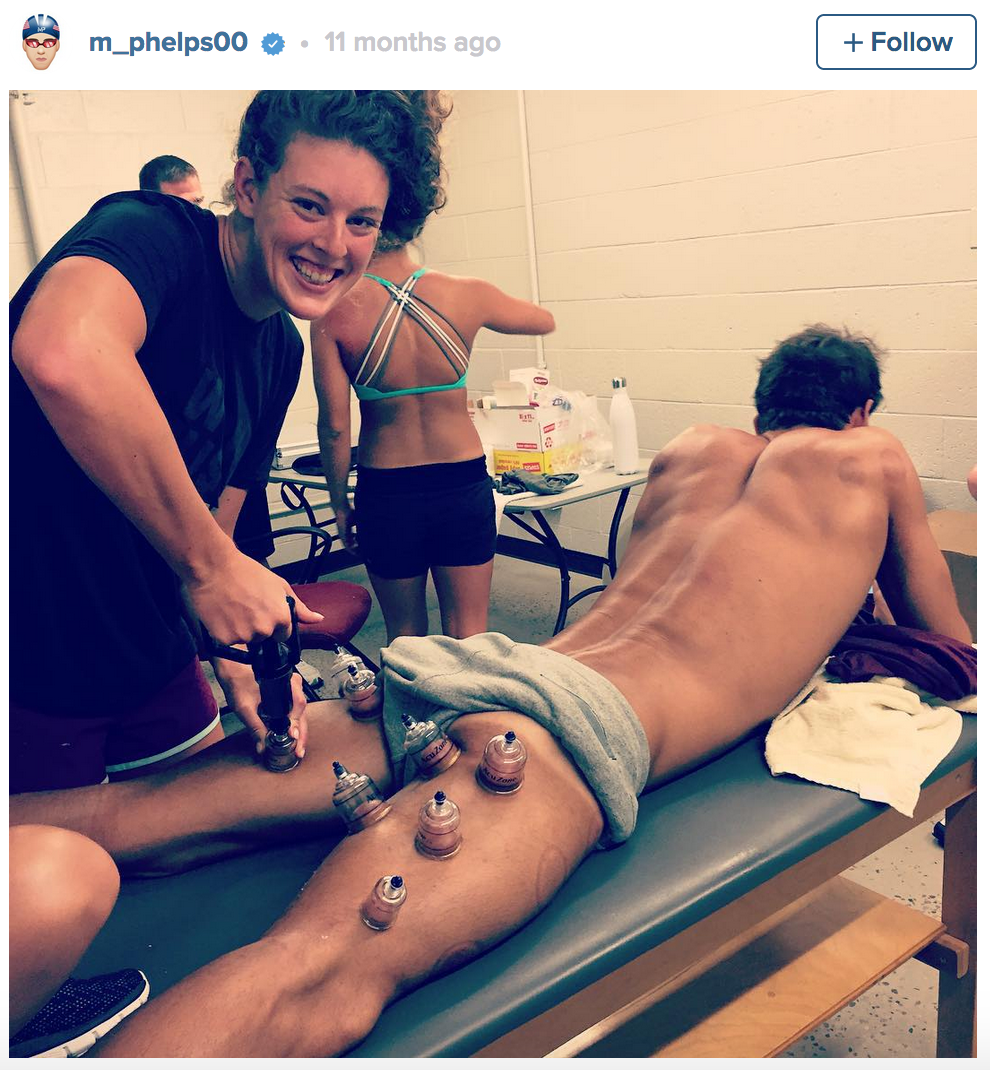
While Yuanhui was exposing the truth about her menstrual blood, Michael Phelps was addressing another type of blood build up that appeared in the form of blotches all over his body. Olympic coverage in Rio was the first time many Americans heard about cupping and other methods of complementary and alternative medicine (CAM) but it was the moment hunkadunk Michael Phelps shared a pic of his bodacious booty covered in suction cups on Instagram that many of us really turned an eye towards non-traditional forms of medicine.
Originating in the East almost three thousand years ago, traditional methods involved cups made of bamboo bark and flames within to suck out the oxygen; modern practitioners have turned to glass domes with hand-held pumps to control air pressure. Cupping involves creating a negative force of pressure over the underlying skin and muscle, causing increased blood circulation, soft tissue expansion, and the loosening of the connective tissue between the skin and muscles eliminating much of the tension and allowing for a greater range of motion. Both cupping and acupuncture are arguably better than deep tissue massage since the pressure and digital manipulation can often cause micro-tears and add to the inflammation.
Although hotly debated for its efficacy, cupping has been rumored to aid with muscle pain, arthritis, insomnia, fertility issues, skin problems including eczema and acne, respiratory disorders, including the common cold, pneumonia and bronchitis, fibromyalgia, and has also been used as an alternative treatment for cancer. Patients argue that it also helps recovery time, a testament to which is the growing list of Olympians using it during the games.
Like other complementary and alternative medicine (CAM), the jury is still out on cupping as well as most other forms of non-traditional or Eastern medicine including homeopathy, acupuncture, aromatherapy, chiropractic manipulation, reflexology, and hypnosis. The National Institute of Health archives promising research results for CAM however, and surveys show that an average of 40% of American adults have tried a CAM option or treatment in the past with about half trying it at some point in their lifetimes.
Regardless of the lack in promising research, alternative medicine is on the rise and has been for the last few decades as patients become more educated about their treatment options and on the harmful side effects of drugs. There is also a movement of people more and more willing to try non-traditional medicine methods as they see the fallibility of Western medicine; in fact, several US hospitals now offer aromatherapy satchels for chemo patients, a clear indication of CAM efficacy, and at least three hospitals in the United Kingdom offer CAM services, under protection of the NHS insurance system!
As the world becomes more accepting of menstruation and CAM treatments like cupping, and Olympians lead the awareness campaign through their use of social media, we ask you to keep an open mind and share your experiences with us too!
As a company that makes organic tampons and natural feminine hygiene products to help alleviate common menstrual related symptoms, like vaginal irritation, we understand the benefits of exploring alternative natural treatments and breaking taboos. Tweet us your thoughts, your own CAM stories, favorite slogans to end period-shaming, Olympic photos, and favorite at-home remedies so we can keep the movement going!